
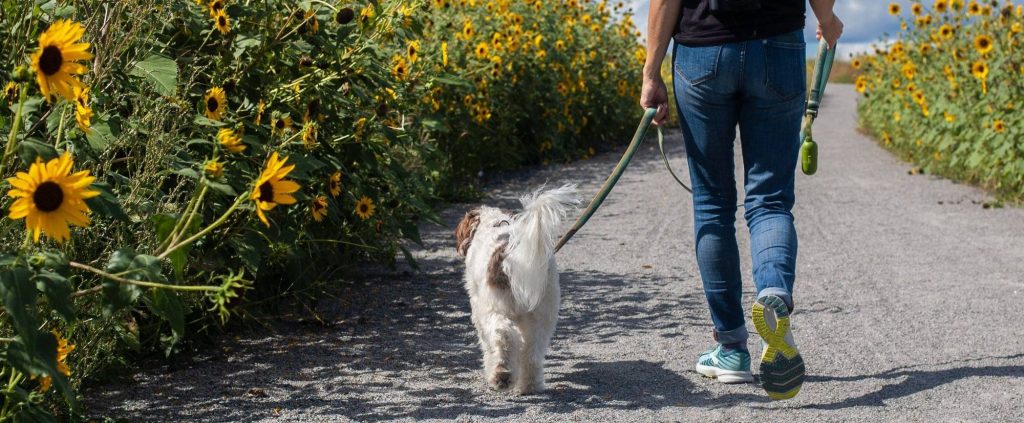
A common question I receive as a dog trainer is how to help people teach their dog to walk on a loose lead. It’s a reasonable request, after all, one reason many of us bring dogs into our lives is to share walks; we dream of days out exploring with our furry friend, perhaps stretching their legs on a long sandy beach but also, where needed, walking in unison on lead, at a calm and gentle pace.
The reality doesn’t always pan out like that…! Perhaps on a particularly challenging day you find yourself being pulled from place to place while Fido explores, seemingly oblivious to the human at the other end of the lead. You arrive home feeling flustered and frustrated, possibly with one arm now longer than the other, wondering if anyone actually had a good time?
Let’s explore our expectations for a moment. Our natural pace and gait are quite different to dogs. We like to amble along in a relatively straight line while dogs naturally move faster, often zig-zagging or with changes of pace as they switch between moving and stopping to sniff. Dogs may pull on the lead through excitement or if they feel worried about something in the environment. A dog with an underlying physical issue may simply be unable to walk at our speed. Only a vet can diagnose medical issues so it’s always important to check in with yours if you have any concerns.
While we see the world with our primary sense of sight, our dogs’ primary sense is smell. Scents move with the air so their environment may be changing constantly, offering new information to explore and new things to process with every fresh breeze.
So, what can we do? The first step to beautiful loose lead walking is connection, and this takes time. Games based training can help here, encouraging our dog to engage with us, building that bond and reinforcing that being near us is a great place to be! We can also use calm, meaningful engagements to connect with our dog out and about; not all play has to be high energy and fast paced!
We can also use positive reinforcement methods to teach our dog where we’d like them to walk, be that heel position or simply near to our side, and reward them for being near to us. We can set our dog (and ourselves!) up for success by breaking training down into small achievable steps, practising in quiet environments first before practising around more distractions and rewarding successes, however small they may seem at first.
Loose lead walking is one of my favourite things to teach so if you and your dog would like a bit of help with this, take a look at my One to One Training Packages or get in touch to see how I can help.

